

The USGA and R&A finally took a step to squash the ridiculous trend of home viewers calling in rules violations with a new local rule for 2018.
Finally, an attack of common sense has come to golf in a new local rule that will squelch Barcalounger and couch potato rulings, and the penalties that come with them. It’s long overdue
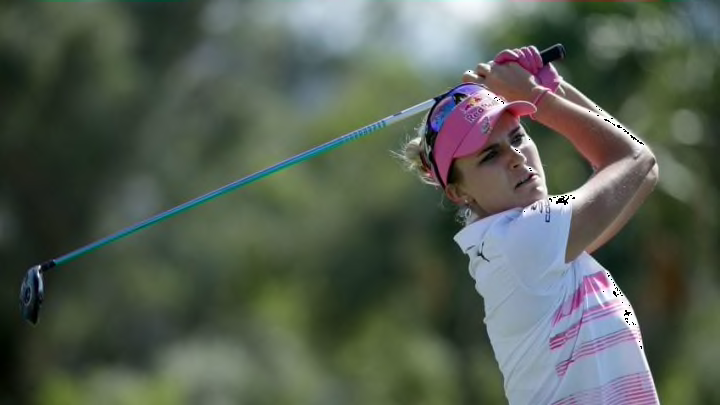
The USGA, R&A and professional golf tours around the world, including the PGA Tour and the LPGA, have announced that they will no longer take calls, emails, carrier pigeons or any communication from armchair experts who believe they have seen a rules violation and are determined that a penalty should be assessed. This change in attitude does not have an official decision number or a rule number, but you know it is going to be called the Lexi Thompson rule. However, the USGA and R&A are calling it a new Local Rule for 2018.
To recap the Thompson situation, on Sunday of the 2017 ANA Inspiration, the LPGA received an email about a possible Thompson rules violation on Saturday. Thompson was then on the 7th hole of her final round. Officials reviewed the Saturday video, but it took them another five holes to notify Thompson of the infraction, which they did as she was walking to the 13th tee. Thompson was leading the tournament then, but on the spot, she was assessed a four-stroke penalty, a two-stroke penalty for playing her ball from the wrong place and an additional two strokes for signing an incorrect scorecard. Hmmm. Bad timing, to say the least.
To say this caused a little kerfuffle is an understatement. Guess what? That kind of thing won’t happen again. No calls will be taken. No emails will be reviewed. Or if they are, they will be dismissed. No amount of whining or discussion will cause more strokes to be added to any player’s score other than the strokes that should have been added for the penalty. Period. And the rules officials on site will have the final say.
The various professional and amateur associations around the world will adopt what they term “active monitoring” of televised golf to eliminate situations where someone mentions an infraction a day after a round has finished, as well as to catch ones that may happen in televised groups during play on the spot.
That’s not to say that playing the ball from the wrong spot or any other infraction won’t have a penalty. It will. But what the new local Rule for 2018 will do is to keep the rules reviews and assessments in the purview of the rules officials on site. So social media, Twitter, Instagram, AT&T, Verizon, Sprint, and T-Mobile, stand down.
This, combined with the other USGA action, Decision 34-3/10 handed down last April, make such good sense it’s impossible to argue against them, although I’m sure many will.
Decision 34-3/10 said, more or less, that when video shows a rules infraction that no one could have seen with the naked eye, it’s not a penalty. And that players can use their “reasonable judgment” to determine a location when they apply the rules.
You could think of the first part of 34-3/10 as the Tiger Woods at the 2013 BMW Championship rule, when Tiger Woods got a two-stroke penalty because video, enlarged a gazillion times taken from ground level and shot at the level of the back of his golf shoes between Woods’ feet, showed that his ball depressed slightly when he moved a loose impediment.
From above, where Woods was standing, that could have looked like an oscillation, which is what Woods believed it was. Nevertheless, he got two shots added because of video screen enlargement from an angle that only an earthworm or large ant or a contortionist from Cirque de Soleil doing a backbend could have seen.
There are many times when an angle like this or an extremely enlarged slo-mo replay show us things that the player, at the time of that situation, could not see with the naked eye. That is what happened to Anna Nordqvist in the 2016 Women’s Open. During the playoff, on the second hole, she apparently grazed the top of the bunker and disturbed a few grains of sand. In slo-mo and enlarged, some sand grains took a tumble. Realistically, standing over the ball, could she have seen that happen? Probably not. And that’s what Rule 34-3/10 is meant to handle.
Can the USGA and R&A actually follow through to ensure rules are enforced fairly – and in a timely manner?
The USGA has asked viewers to have confidence that rules officials are looking at the telecasts and that officials are monitoring in real time what is happening on the course.
In the past, if officials believe there was a rules infraction that any player might not have been aware of, they have always done their best to speak to the player before a scorecard is signed. If it is discovered that there was a penalty not caught by the player and caught by rules officials, then the appropriate penalty will be added to the player’s score, and everyone will play on from there.
Now, the only thing left is for officials to provide more timely review of incidents. Perhaps a play stoppage should be instituted when the outcome of the ruling affects the outcome of the tournament, as it did in the case of Thompson and of Anna Nordqvist at this year’s Women’s Open and at the 2016 U.S. Open won by Dustin Johnson. They stop the NFL play for important rulings. Why not golf rulings for the Men’s or Women’s U.S. Open?
Next: Stricker, O'Hair snap winless droughts at QBE Shootout
Why should a player be left in the dark when he or she might employ a different strategy if there was a possible penalty stroke? Should players be given the right to stop play when there is a rules situation that is unresolved? Or practically speaking, should play have stopped when Dustin Johnson got one kind of ruling at the U.S. Open when it was clear that other players on the course were getting different rulings for the same situation? That shows that when it comes to the rules, the work is never done.
 Add us as a preferred source on Google