

It’s one of the biggest mysteries in golf. Why do some top-name players have poor records in match play?
Sometimes, lower-ranked players can create surprising upsets in match play. There are guys who just transform like Clark Kent going into a phone booth or broom closet and coming out as Superman. We’ll offer a few theories about why this happens.
First, match play is a different animal than a four-round tournament, which is the standard for men’s professional golf. Over the course of four days, a golfer can take advantage of his ability to gradually gain momentum and make birdies. Even if he has a bad round, he knows he probably won’t have four bad rounds. A good round is just around the corner.
That scenario perfectly describes the Scottie Schefflers and Tiger Woodses of the world. Determined, diligent, persistent winners like Scheffler and Woods rise to the top over the course of a four-round event. They may even toss in a 64 or 65 on one day, but you never know which day it will occur. What you do know is that, come Sunday, they’ll be there or thereabouts. If not leading, they will wait for a chance, for the hole where the leader makes a mistake. Then they’ll pounce and put claw marks on their opponents’ backs.
Second, Scheffler is, as Paul McGinley described him on Golf Channel just before the Presidents Cup began, like a big diesel engine that takes some time to get going. It may take a round to get into the flow of the tournament. Then he chugs his way up the leaderboard reaching for the top. Most of the time, he gets there.
For purposes of comparison, McGinley used Europe’s Ian Poulter, who was not a world beater week in and week out, but could somehow rise to the occasion and beat people he had no business beating over 18 holes in the Ryder Cup. He could do that in stroke play for a round or two.
Poulter proved McGinley's point in 2018 at the World Golf Championships-Bridgestone Invitational, when he fired a first-round 62 to lead the field. The field happened to include Tiger Woods, who was four strokes behind him. (Neither Woods nor Poulter won the tournament.)
McGinley called Poulter a sprinter-type golfer, one who can show up and be brilliant for 18 holes, but perhaps no longer than that, like a shooting star that burns itself out and falls from the sky. When it came to the Ryder Cup, Poulter had an extra gear. His record was 15-8-2. Yet, he had just three victories on the PGA Tour and 10 on the DP World Tour. His Ryder Cup point percentage in seven events was 64 percent overall and 94 percent in singles.
Comparing Poulter’s point percentage in Ryder Cup to that of Tiger Woods, Woods had a Ryder Cup point percentage of just 39.2. But of course, Woods has won significantly more tournaments than Poulter. In the Presidents Cup, Woods' point percentage was 64 percent.
Third, there are the players who just become temporarily invincible. Take Aussie Nick O’Hern. In the WGC Accenture Match Play in 2005, O’Hern beat Woods 3 and 1 in the second round. He didn’t just do it once.
In the third round of the WGC Accenture Match Play in 2007, O’Hern was again the giant killer. He took Woods down for the second time,1-up in 20 holes.
“The good thing was I just told myself I've been in this situation before, and I know how to handle it, and it's a matter of how you handle it is the most important thing,” O’Hern said about the match. “When he's coming at you like that, you can lose your focus and play poor golf, but I still played nice, solid golf.”
He said beating Woods twice in match play was something to tell the grandkids later on in life.
Somewhere along the line, I asked O’Hern what he did to beat Woods. He stopped, paused, and said he had decided not to look at him the whole match. Not once, ever. O’Hern wore wraparound sunglasses then, so it was hard to tell where he was looking. We have to take his word for it. It takes a lot of fortitude to never look at your opponent, but it worked for him both times.
Fourth, there’s the overall competition factor. The level of golf played around the world is different. It’s higher in the U.S., top to bottom, than in some other countries. Not to speak disparagingly of anyone, but the U.S. has more golf courses and plays more rounds of golf than any other country on the planet. It’s only natural that we should have more very good golfers than anyone else.
Fifth, as Nick O’Hern said 20 years ago at the Presidents Cup, “Match play is a funny game, and if you just start hitting the shots and holing some putts, anything can happen."
Sometimes a guy just plays badly. You've seen the golf excuse T-shirts. It can be anything from an upset stomach to the sun glinting off the putter head that sets them off.
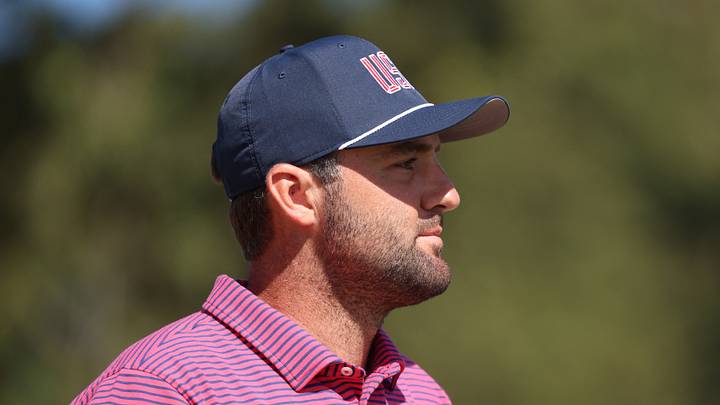
At the recent Presidents Cup, the U.S. team was in a hole by Sunday morning, but they were able to turn it into an amazing victory by Sunday evening. Here's how:
Tom Kim, the International's biggest star, was one of the few who was able to win his point, and it was against Wyndham Clark, who just played tired golf.
Scottie Scheffler finally found his form and dragged Nico Echavarria to the 16th before handing him a 2 and 1 defeat.
Cameron Young regained his strength and scored the first point of the afternoon when he downed Ryo Hisatsune, 3 and 2 at the 16th.
Justin Thomas just rolled Corey Connors 5 and 3. Connors struggled mightily with his putting on Sunday.
Sam Burns, who had made excellent putts for most of the first four days, found the lid had been put on the hole on Sunday. Sungjae Im kept him at bay even though he kept coming back to tie. That lasted until the 13th when Im took the lead. He finally closed Burns out at the 17th.
To absolutely no one's surprise, Chris Gotterup started strong and finished strong. In the middle, though, Christiaan Bezuidenhout, rallied to challenge him all the way to the 18th hole, which Gotterup won with two putts.
Collin Morikawa was pitted against Hideki Matsuyama in a nail-biter that went all the way to the 18th hole, where Matsuyama's bogey gave the U.S. another point.
Patrick Cantlay, otherwise known as Patty Ice when he plays in team events, lived up to his name once again. He was able to freeze out Adam Scott, who was the sentimental match favorite, with a 57-foot birdie putt on the 16th. That gave Cantlay a one-stroke lead, and he cemented his victory on the next hole.
Super-rookie Jackson Koivun defeated super-stud International player Si Woo Kim. Kim took him all the way to the 18th hole, however.
Captain's pick Jacob Bridgeman proved that he was worth being chosen. He secured the hard-fought point when Min Woo Lee made bogey at the 18th.
Two great putters faced off when Russell Henley tussled with Canadian Nick Taylor. After making scores of clutch putts all week, neither was able to outdo the other. Each walked away with a half point.
Xander Schauffele and Ryan Fox, two recent British Open champs, faced off in the final match on the course. Schauffele wasn't about to lose. He made six birdies during the round and hammered the victory home with a 15-footer for another birdie at the 17th.
Starting from a three-point deficit, the U.S. won nine of the 12 singles. Instead of putts rolling in for the Internationals, enough of them rolled out. Instead of balls landing in the fairway, they hit some rough or found bunkers. In golf, like life, luck counts, and it just rolled away from the Internationals and over to the U.S. team on the last day.
Those who were upset at the U.S. team's play early on should know that many exceedingly special Tour players have had difficulties in Ryder Cup or Presidents Cup. Some of these won/lost examples will raise your eyebrows:
- Tiger Woods, winner of 82 PGA Tour events: Ryder Cup, 13-21-3, Presidents Cup, 27-15-1
- Curtis Strange, winner of back-to-back U.S. Opens: Ryder Cup 6-12-2
- Lanny Wadkins: Ryder Cup, 17-11-3
- Fred Couples: Ryder Cup, 7-9-4
- Paul Azinger: Presidents Cup, 5-8-3
- Scottie Scheffler: Presidents Cup 6-6-1; Ryder Cup, 3-6-3
- Hideki Matsuyama: Presidents Cup,11-15-5
- Ian Poulter: Ryder Cup, 15-8-2
- Nick Faldo: Ryder Cup, 20-19-4
- Seve Ballesteros: Ryder Cup, 20-12-5
- Sergio Garcia, all-time-points leader for Europe: Ryder Cup, 25-13-7
- Colin Montgomerie: Ryder Cup, 20-9-7
- Rory McIlroy: Ryder Cup, 19-14-5
And comparing them to the great yardsticks of the game:
- Arnold Palmer, Ryder Cup, 22-8-2
- Jack Nicklaus, Ryder Cup, 17-8-3
 Add us as a preferred source on Google