

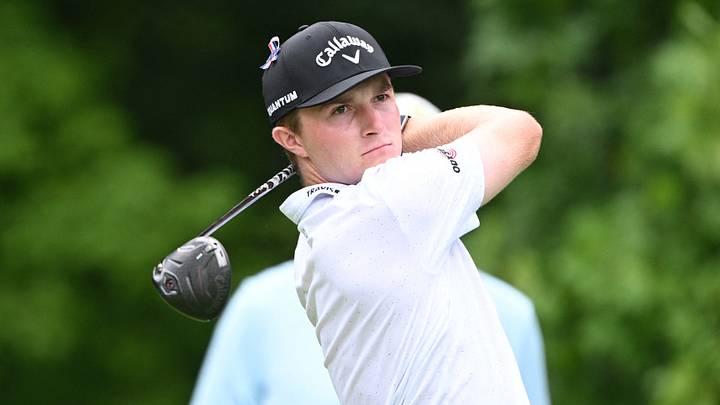
It’s about to be harder to become a full-fledged PGA Tour player. The new system devised by the Future Competitions Committee is changing how everything works.
You can thank Tiger Woods and the Future Competition Committee, or you can thank LIV Golf, but one way or another, it’s going to be harder to get to the PGA Tour starting in 2028 and beyond. First of all, there will be fewer cards for the Championship Series tournaments, as there will be 100 instead of 125.
This season and last, we have had a bumper crop of newcomers, including Blades Brown, Ben Jones, Neal Shipley, Gordon Sargent, Luke Clanton, Johnny Keefer, Aldrich Potgieter, Nick Dunlap, and David Ford, to name just a few.
When asked if he thought the reason so many young players were trying to get some status before the changes make it harder to get a PGA Tour card, Davis Love III, host of the RSM Classic, said he believed it did.
“I'm sure that a lot of them are speeding up their decision,” he said. “I think guys are probably looking at that. Everybody's thinking right now, that's the big thing, thinking what's best for my future.”
He remembered what he did before he went to Q-School, which was the path to the PGA Tour when he was a young golfer.
“I didn't want to play PGA West Q-School, so I turned pro a year early and went to Grenelefe in Florida because I knew I loved the golf course, and sure enough, I got in,” he recalled.
Love was not alone in that decision. Many aspiring golf pros did not want to play the PGA West Q-Schools because the courses were and are very difficult, requiring precision play. PGA West Stadium course was taken out of the American Express tournament in 1987 after the first playing because it was considered too hard for the pros compared to the other courses they played. Usually, two or three courses were involved, and no one wanted to get PGA West Stadium on a windy day.
For some players, the way they go about getting professional status might make a big difference. Love thinks that for others, like a Blades Brown, who won a couple of weeks ago, or a Ben James, who was runner-up to Brown, losing to him in a playoff, it might not matter.
“Obviously, I've seen a lot of system changes,” Love, who turned pro in 1985, noted. “No matter what, you're not going to stop Blades Brown. He's going to get there one way or another. Tiger Woods is going to get there one way or another.”
What Love means by that is some young golfers have so much talent that they are unstoppable, like Rory McIlroy was when he turned pro, like Seve Ballesteros was when he started playing professionally. And as far as ultra-young players go, right now, there are two high schoolers that people are eyeing: Miles Russell of Jacksonville Beach, Florida, and Ethan Fang, of Plano, Texas.
“Those guys look like they have been ready for it for a long time,” Love added about the new crop of players. “I think the difference now is they're coming out with a team around them. They're coming out, you know, a lot of these guys as amateurs now have their managers and their teams built before they even turn pro, so I think they're better prepared.”
 Add us as a preferred source on Google