

Anybody who plays golf or who has played golf for part of their life knows what wind does in this game.
Wind can stand a ball up and nearly stop it in mid-air. It can push it from beyond the rough on one side of a hole into a water hazard on the other side. What kind of wind does that? Strong wind, that’s what. That's what they had at Aronimink Golf Club at the PGA Championship on Friday.
Nothing but experience prepares a golfer for conditions like those at the PGA in the first two rounds. And while golfers wouldn’t go so far as to say it was unfair, challenging was used often.
In addition to the wind, there were what could at least be called creative pin placements.
“I think the thing that's hardest to see is that every hole location's on a crown,” said Maverick McNealy, who is tied for the lead at 4-under par. “From TV, everything looks kind of flat, but you get up there, and everything's on a crown. If you miss the putt right, it breaks right. You miss a putt left, it breaks left.”
It seems that 36 holes of that would send golfers running into the woods screaming, but there are there for as long as possible.
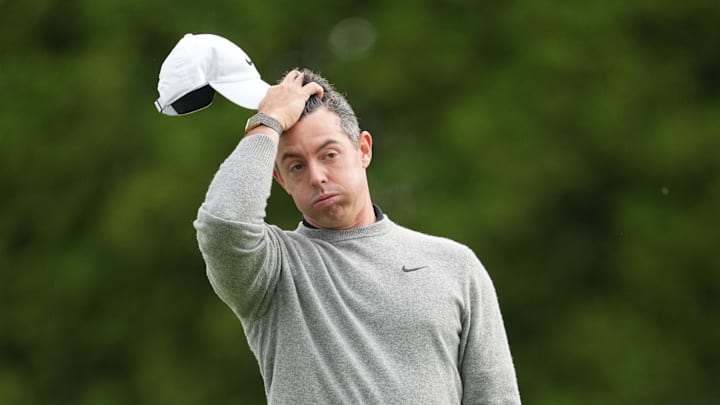
Rory McIlroy talked about the lack of birdies.
“It's been hard to make birdies out there because obviously, one, the wind the last couple days, but also where they have put these hole locations,” he noted. “I feel like they have really tried to protect the course the first couple of days. So, it seems like they have used up a lot of the really hard ones.”
He was surprised at the course setup, comparing the practice rounds to the actual tournament days.
“I certainly didn't, in the practice rounds, I certainly didn't see it playing as difficult as it has played,” he said. “I think a bunched leaderboard like this, I think it's a sign of not a great setup, I think, when it's as bunched as it is, because it hasn't really enabled anyone to separate themselves.”
Scottie Scheffler thought the location of the flag on the 14th was less than desirable.
“That was one of the craziest pins that I've seen just in terms of it wasn't -- your ball wasn't going to roll off like 50 yards away, but that was like they put the pin on like this microphone, like it was just like a high point. I hadn't seen anything like it,” he said.
He called it the hardest pin he had seen in a long time.
“There's literally just like a spine and they're like, oh, we'll just put the pin right on top of it. And you're like, all right, well, I'll see what I can do. And just you know, just challenging,” he explained.
He added that if it was hard for him, he knew it was hard for the rest of the field. He wanted to make sure he wasn’t the only one that thought they were a little over the top, so he checked with his caddie, Ted Scott who, before working for Scheffler was a caddie for Bubba Watson, among others. He also asked Fooch, Justin Rose’s caddie.
Fooch and Scott said the only place comparable would be Shinnecock Hills in the 2018 U.S. Open. During that tournament, Phil Mickelson was so frustrated with the greens that he hit his own moving ball to keep it from rolling back down the fairway.
“This is the hardest set of pin locations that I've seen since I've been on Tour, and that includes U.S. Opens, that includes Oakmont,” Scheffler added. Oakmont’s greens he called severe, but said they were “severe in one direction.”
Others were seeing a similar “challenge.”
“Every green speed has a percentage (of slope) that a ball will not stay (on it when it’s windy). So, I would like to think and hope that anybody who is setting a golf course is not going to put a pin in that percentage,” Justin Thomas said after his second round.
Even relative newcomer Chris Gotterup offered an opinion.
“I think it's a little more almost U.S. Open-esque,” he said. “Even if it's a generic shot, if it's blowing 30 off the right, you've got to be able to craft something that is manageable to get it in the middle of the green.”
He did point out that pins placed where some of them were on Friday affect the pace of play, too. The 14th, he called “probably aggressive.” The 12th, he noted, was four paces on the green and on a shelf, and it was straight downwind.
“No one's going to try to skip it up there and stop it on the shelf. You're just going to have 25 feet, which is fine, it's not unfair, but you're not going to see a lot of shots that are hitting next to the pin and spinning back there,” he said.
Scheffler said he was surprised at the difficulty of the pin placements.
“When you're looking at the pins Wednesday night you see it, you're like, oh, wow, they're pushing these things as far as they can, and you go, okay, great. Then you know going into it,” he summed up.
Golf Monthly came up with a formula that indicates that for every 1 MPH of wind speed, add 1 percent to the headwind. Or, your 100-yard shot with a 5 MPH headwind becomes a 105-yard shot. But just having the formula probably won't make any golfer feel better about the score if a ball gets blown into the water or off the green!
 Add us as a preferred source on Google