

At long last, the stage is set for the start of the 2026 PGA Tour season, which kicks off this week with the Sony Open in Hawaii at Waialae Country Club.
With a number of phenomenal host sites on the regular rotation, it's time to examine the best weeks of the year for golf course enthusiasts.
So, with that in mind, here's our ranking of the top five golf courses on the PGA Tour schedule, excluding the major championship venues.
5. Arnold Palmer's Bay Hill Club & Lodge - Arnold Palmer Invitational, March 5-8
A key part of March's formidable Florida Swing, Arnold Palmer's Bay Hill Club and Lodge hosts the Arnold Palmer Invitational, one of eight Signature Events this season.
While the original layout was designed by Dick Wilson, Palmer purchased the club in the 1970s and made the course his own, creating a layout that continues to be extremely stressful and extraordinarily difficult.
There are several holes where water hazards must be navigated from tee to green, and the large putting surfaces are severely pitched. Bay Hill features one of the toughest finishing holes on Tour with its extremely narrow fairway and the massive banana-shaped green guarded by water short and right.
The signature hole here is the famous par-5 sixth, a 589-yard horseshoe that bends 180 degrees around a huge lake. It is a spectacular risk-reward hole where players must continually choose how aggressive to be in their carry over the water. The green can be reached in two with a bold drive, but a tee shot into the lake could result in a gigantic number. John Daily found out the hard way when he made an 18 here in 1998.
4. TPC Sawgrass (Stadium Course) - The Players Championship, March 12-15
The Stadium course is one of the more famous stops of the year, hosting the PGA Tour's flagship event, The Players Championship.
There are many highly memorable holes in this layout: The tricky par-4 fourth is short but very narrow with a creek running tight to the front and left side of the green. The sixth got its fire back with the restoration of the overhanging tree in front of the tee box, which players must take care to drive the ball below.
And, of course, the legendary finish with the island-green 17th followed by the ultra-difficult 18th that has water hugging the entire left side.
The Stadium Course, like many Pete Dye designs, thrives on visual intimidation. There are opportunities to score here, but even slight misses are harshly punished and can result in disastrous scores.
3. Muirfield Village Golf Club - The Memorial Tournament, June 4-7
Possibly the toughest venue on the PGA Tour schedule, Jack's Place is a brilliant championship venue that requires elite shot-making to have success.
The greens are fiery and dramatically sloped, the rough is brutal, and there is a plethora of water hazards pervading the entire layout. There is never a dull moment at Muirfield Village, as architect Jack Nicklaus modeled a number of holes off Augusta National; for example, the par-3 12th is more or less a longer and harder version of Golden Bell, Augusta's iconic 12th hole.
The final three holes are among the hardest finishing holes in the world. The par-3 16th, set up similarly to Augusta's 16th, plays 218 yards to a two-tiered green with water short and left. The 503-yard 17th is a stiff par-4 with an elevated green sitting just beyond a small stream.
The notoriously difficult finishing hole has parallels with Augusta's 18th as a long dogleg right with an extremely narrow and difficult tee shot. The uphill approach plays to the most severely sloped back-to-front green on the course.
2. Riviera Country Club - The Genesis Invitational, February 19-22
With the Monterey Peninsula dominating the attention of the early-season California Swing, Riviera Country Club sometimes seems to be a little understated; however, it is considered one of the world's greatest golf courses, frequently ranking in the top 25 in the world.
The iconic par-3 sixth stands out, a 199-yard hole with a small bunker smack in the middle of the green. The putting surface itself has four small tiers, dividing the green into small square sections that all sit at a different level. This phenomenal hole has been replicated in numerous places around the world.
The 315-yard 10th is considered one of the very best short par-4s in golf, although calling it drivable is a bit misleading. The green is positively miniscule, less than 10 yards wide at the back, and is surrounded by bunkers, so it is practically impossible to hit with any kind of wood. The goal is to poke the ball just short and left of the putting surface to leave an easy uphill chip; however, this requires great precision, and missing the green pin high can become an absolute nightmare leading to a ping-pong game back and forth across the slick putting surface.
Finally, Riviera has a difficult and celebrated finishing hole, a 475-yard par-4 that starts with a blind tee shot over a shelf to a very narrow fairway. The green is also narrow and quite small, nestled wonderfully against the enormous hill with the splendid clubhouse towering 50 feet above. The surroundings create one of the great natural amphitheaters in golf and a tremendous finish to a wildly interesting 18 holes.
1. Pebble Beach Golf Links - AT&T Pebble Beach Pro-Am, February 12-15
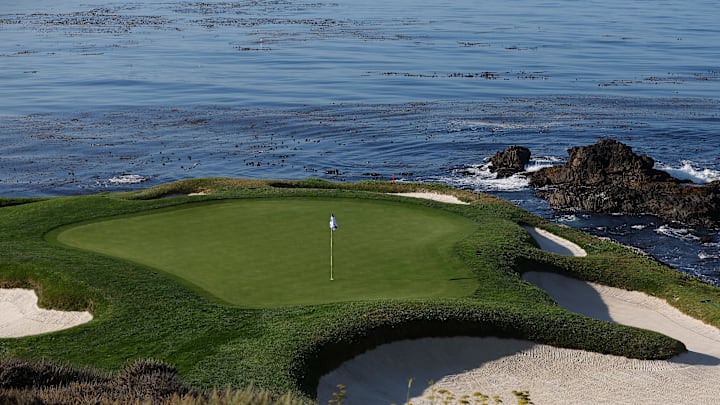
It likely comes as no surprise that the best golf course on the PGA Tour schedule is Pebble Beach. No other stop compares with the stunning cliffs and ocean views provided by this American treasure. With nine holes directly on the ocean, holes six through eight comprise one of the greatest three-hole stretches of golf in the world.
They begin with the short par-5 sixth, which famously plays to the top of a massive shelf and straight out toward the sea. The par-3 seventh may very well be the most famous and recognizable hole in the entire world, only 107 yards downhill to a tiny green that gets showered with spray from the Pacific Ocean. Then comes the par-4 eighth with its long second shot over the cliffs to the minuscule beachside green, believed by many to be the toughest approach shot found anywhere.
The inland holes are often criticized for being uninspired and disappointing compared to the ocean holes, but this comparison is unfair. Many of the inland holes have their own unique traits and tricky quirks that are displayed in a more subtle way. The 580-yard 14th is a brilliant par-5 that doglegs hard to the right and features an extremely small kidney-bean green that slopes away from the golfer, a daunting target that sits just beyond a gaping sand-faced bunker.
Everything reaches a final climax at the par-5 18th, one last world-famous hole that never leaves the edge of the ocean. The AT&T Pebble Beach Pro-Am always brings excitement, as the world gets to take in this breathtaking monument of American golf.
 Add us as a preferred source on Google