

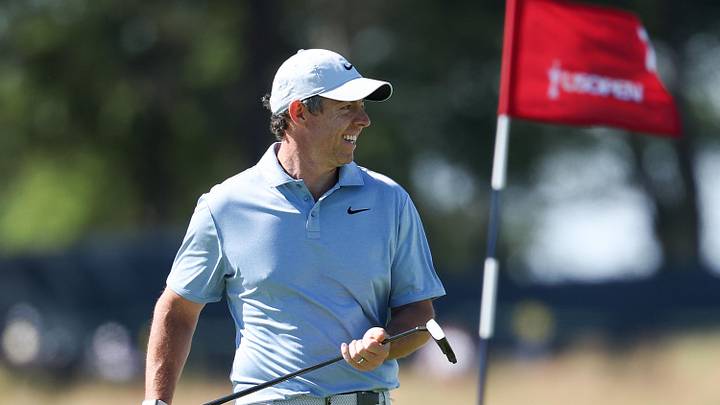
Rory McIlroy holds Shinnecock Hills Golf Club in high regard and thinks it may actually favor European golfers at this year’s U.S. Open, touching on that topic and several others in his press conference prior to the year's third major championship.
McIlroy is chasing down his second U.S. Open, the first one coming at Congressional in 2011, just two months after his infamous blowup on the back nine during the final round at The Masters
It was an incredible achievement for him to turn his game around so quickly, mentally, from disaster to victory, but McIlroy is nothing if not an incredible player. He proved that by winning the career Grand Slam last year and repeating as champ at this year’s Masters. Now, he's chasing that feat for a second time.
In the past, the U.S. Open was known for narrow fairways and super-high rough. It has not typically been the successful hunting ground of European players. It has traditionally been won by U.S. golfers who have grown up on courses where the rough has teeth, and the greens have speeds like the Indy 500. European victories were few and far between.
How few? Between 1925 and 1970, no Europeans won it. Tony Jacklin broke through in 1970. But after that, it took until 2010 for another one to do so, and that was Northern Ireland’s Graeme McDowell. Then came McIlroy, and a couple of years later, Justin Rose and Martin Kaymer. The last two Europeans to win it were Jon Rahm and Matt Fitzpatrick. It’s not such an anomaly anymore.
Along the way, there were Australian winners, a New Zealand winner, South African winners, and even a South American winner. So, the trophy has graced mantels on five continents.
In the past, the setup of the course, a long, narrow ribbon of fairway and slicker than black ice putting surfaces, has made it difficult for those who grew up in other places to acclimate themselves to the typical U.S. Open. But McIlroy thinks that Shinnecock Hills flips the script, giving foreign-born golfers, especially those who have played a lot of links-style golf in Ireland, Northern Ireland, England, and Scotland, the advantage.
“I think just over time we've got a lot more comfortable with the style of golf that you need to play and the setups around here,” he said in his press conference. “I would say this is more a UK/European style of test than certainly the first two majors at Augusta and Aronimink. So, it certainly wouldn't surprise me to see a few players from Europe and the UK in contention on Sunday.”
It shouldn't surprise us to hear that. Shinnecock was, according to most sources, the first 18-hole course in the United States. Golf design at the time borrowed a great deal from the UK. However, today's Shinnecock is not the same course as the 1891 version. It was revised by William Flynn in 1931. Flynn also designed The Country Club in Chestnut Hill, Merion Golf Club (with Hugh Wilson), Cherry Hills CC, Philadelphia CC, Huntingdon Valley CC, Lancaster CC, and others.
The last time a U.S. Open was played at Shinnecock, 2018, balls were reluctant to remain on the putting surfaces. That was the year when Phil Mickelson hit a putt, chased it as it ran by the hole, and then hit it again while it was still moving so it wouldn’t roll into the fairway. To say players were frustrated by the course conditions was an understatement. No one wants that again, but whether or not we get them is in the hands of the USGA.
This week, Michael Kim actually said the greens were “quite bumpy,” a condition that is not surprising with poa annua grass, and that he could still see holes from aeriation. Nothing like either of those comments has been said in the past, although on the west coast, players often say putting on poa annua in late afternoon is like putting on broccoli. Perhaps we tread into new territory of criticism.
Now, McIlroy said the greens on Monday were in the 11/12 range on the stimpmeter, and he felt that they didn’t need to be any faster than that. Whether or not the USGA agrees remains to be seen.
“There was only gusts of 25 to 30 yesterday, and balls wouldn't stand on the 11th green. That's where you just have to use a little bit of caution,” he explained. In Monty Python speak, "Nudge, nudge, wink, ink, say no more."
Hopefully someone from the USGA reads that comment. McIlroy pointed out that with late starting times on the weekend, they will at least have time to water the greens if needed.
“Thursday, Friday, they're just going to have to manage a little bit better,” he added. “Every single day at this course, the members play, they put water on the course at 2:00 p.m. So, it's a unique golf course, and it seems like it's just something they have to do.”
Despite the difficulties that lie ahead, Rory had the highest of praise for Shinnecock. "I think if everything is going the way everyone wants it in terms of weather, setup, I think it's the best championship test in the country," he said. "I think it tests all aspects of the game: driving, iron play, you need to have your wits about you on the greens. It's a lot of strategy, thoughtfulness."
 Add us as a preferred source on Google